


The screenshots above depicts my own attempt in utilising the ‘Twine Programme’ with the task being to create an interactive narrative with the topic of ‘BREXIT’ being the main point of reference with 14 sentences related to the said subject matter. links were provided to go to and fro from each page.
The statements were deliberately made controversial to highlight the many talking points the topic of ‘BREXIT’ covers at the time this written. The controversial points meant to spark debate rather than outlining definitive facts.
The work produced is saved on a Mac in Rus 137 in Anglia Ruskin University, Cambridge, England, UK.
Harvard Reference below links to original work/experiment I produced as depicted about in the screenshots;
Chris Klimas, 2019. Twine (1.4.2) [computer programme] Chris Klimas. Available at: <https://twinery.org/2/#!/stories> [Accessed 27 September 2019].
Two Interactive Stories (Research);
Choice of the Deathless (Screenshots of Interactive Story Above)=
The main positives that I can point out when I originally played a portion of this interactive game is how detailed it is in the Prose-esque paragraphs describing the character you slowly become through the four options given in each step as well as the unique worldbuilding over the expanding narrative.
The four options in question always relate to the narrative in hand with a lot of them not being too similar or too outlandish with the inclusion of established characters and locations that were brought in with each option playing a different part in the personalised narrative direction chosen. The character ‘Ashleigh Wakefield’ being one of many elements linking the narrative world together.
It is easy to manoeuvre regarding selecting one of the four options, the sections containing the options always having the less paragraphs which is good so there isn’t a sense of being overwhelmed with the intact of information.
The negative features that I have come across while experiencing this interactive story is the lack of visual illustrations or animations that would’ve, in my opinion, not only added a more modern and accessible aesthetic to the game itself but also would’ve garnered more engagement with the narrative which is informed by the choices chosen using the four-option system.
After further expanding on the programming and presentation of the Interactive Story ‘Choice of the Deathless’ itself, it became evident that it not only requires an update to the font, style or colour scheme but also in how the interactive story itself flows from one choice to another in an engaging manner which I feel is lacking due to these faults addressed in the last couple of paragraphs.
The features that I will consider incorporating into my Final Interactive Story is the skill and craft of creating an interesting narrative and story structure through the practise of Prose which despite being the only feature on the Interactive Story ‘Choice of the Deathless’, it did however work well enough on its own whether its the use of dialogue to the creation of atmosphere and evolving mythos which I feel partially makes up for the lack of visual story telling which will be a part of my Final Interactive Story; creating a balance between these two essential methods of storytelling.
Choice of Games LLC, 2013. Choice of the Deathless (17737). [computer programme] Max Gladstone. Available at: <
https://www.choiceofgames.com/deathless/> [Accessed 27 September 2019].

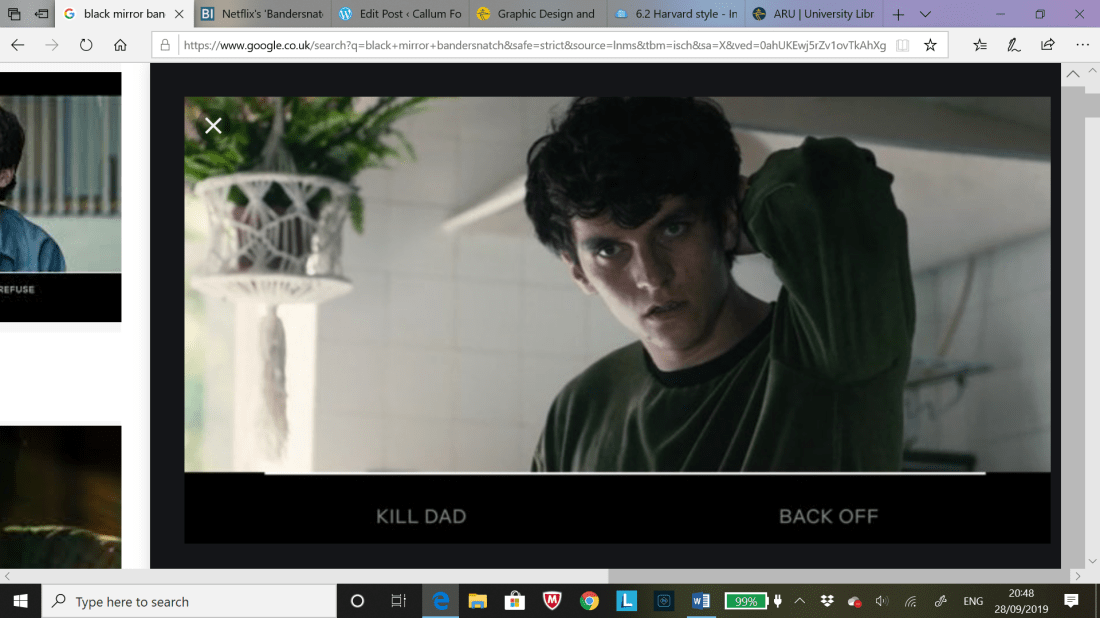
Black Mirror: Bandersnatch (2018) ‘Screenshots of Interactive Story Seen Above’
Positive points that I can draw from engaging with the Netflix Original Programme ‘Black Mirror: Bandersnatch’ is just how well structured, presented and assessable the shows first Emmy Award Winning ‘Interactive Story’ is.
The consistency in the main story points within its narrative is also applaudable after playing the Interactive Film twice with the clips and narrative directions the film offers all blending seamlessly together, like a Lego set where you can rearrange the pieces into different forms but still utilise the same pieces without anything being added or taken away, with the pieces in question being the standard potent themes of the said film that is expected from the work of Charlie Brooker and Annabel Jones.
There aren’t too many options that are brought up every few minutes or so and the footage shot for the film is engaging enough for myself to be completely immersed in the film’s fictional universes with the options that are selected not being too difficult to implement, the tv remote in my case being a good example of this.
The system in which you ‘play’ through the film by choosing different options lasts for a good one hour and thirty minutes with a clear beginning, middle and end forming a proper film experience while also being given the opportunity to go to the end credits if the player (i.e. myself) of the interactive narrative decides to end the session. You can end twenty, thirty or forty minutes in and the film still achieved its goals and story beats although it is worth spending the initial hour and thirty minutes to experience the interactive narrative in its full form.
What became apparent when further experiencing the Interactive Story in question which I felt detracted the enjoyment is how the footage, although well directed and performed, becomes a bit tiresome after a period of time goes by with no added scenes of unexpected twists or turns happening due to the ‘rigid’ story points you have go through to complete and fulfil the films purpose.
I felt this was restrictive and underwhelming even though this was deliberately made the case due to the themes the creators of ‘Black Mirror’ wanted to portray using this tried and tested medium. I’m more disappointed with the lack of extra surprises and routes when you play ‘Bandersnatch’ a second time around despite as I said this being the main intention by the creators themselves.
Varying beats and features that I will consider adopting for my own ‘Interactive Story’ will be the implementation of having clear ‘moments’ and ‘themes’ within the fictional world I’ll create so everything has a structure and is not too fast and loose.
This’ll allow footage or visual images to breath and not be cut short by the ‘player’ having to choose options every two minutes which I found the most appealing while playing ‘Bandersnatch’ although a few more scenarios will be considered in my piece so none of key narrative beats in my ‘Interactive Story’ over stays its welcome and defeats the point of the medium.
I will include a ‘Two Option’ system throughout so things won’t get too convoluted and apply a ‘button’ where you can restart the game or go straight to the end credits if it’s a film or an episode for T.V.
Black Mirror: Bandersnatch. 2018. [Interactive Film] Directed by David Slade. United Kingdom: Netflix.
Netflix, 2018. Black Mirror: Bandersnatch| Netflix Official Site. [online] Available at: <https://www.netflix.com/gb/title/80988062> [Accessed 28 September 2019].
Business Insider, 2019. Netflix’s ‘Bandersnatch’ has many different endings-here are the 9 main ones. [image online] Available at: <https://www.businessinsider.com/bandersnatch-endings-explained-2019-1?r=US&IR=T#7-the-bloody-endings-7> [Accessed 28 September 2019].
Climate Change Research;
The term ‘Climate Change’ can be broken down to different definitions both in science and politics. Roger A. Pielke, Jr Journal Article ‘What is Climate Change?’ expands upon these various contentious definitions of the term due to the use of politics or science as stated prior. The Framework Convention on Climate Change (FCCC) and the Intergovernmental Panel on Climate Change (IPCC) are both compared throughout the article by Roger to highlight the clear divide in opinion upon the topic of ‘Climate Change’.
‘FCCC’ not only focused on ‘International Policy’ but also defines Climate Change as ‘a change of climate that is attributed directly or indirectly to human activity, that alters the composition of the global atmosphere, and that is in addition to natural climate variability over comparable time periods’.
‘IPCC’ however focused on ‘Scientific Assessment’ (Originally in support of the FCCC) with its broad definition of Climate Change being ‘any change in in climate over time whether due to natural variability or as a result of human activity’. These different interpretations of the definition for Climate Change has lent itself for endless politicized debate that is continuing today.
Pielke, R.A., 2004. What is Climate Change?. Issues in Science and Technology, [e-journal] 20 (4). pp.31-34. Available through; Anglia Ruskin University Library website <http://library.aru.ac.uk> [Accessed 04 October 2019].


 Callum Forster